Espresso troubleshooting
Espresso channeling is a flow problem before it is a grinder problem.
If one shot runs cleanly and the next sprays, gushes from one spot, or tastes sharp and harsh at the same time, the puck may not be offering water the same resistance everywhere.
Updated
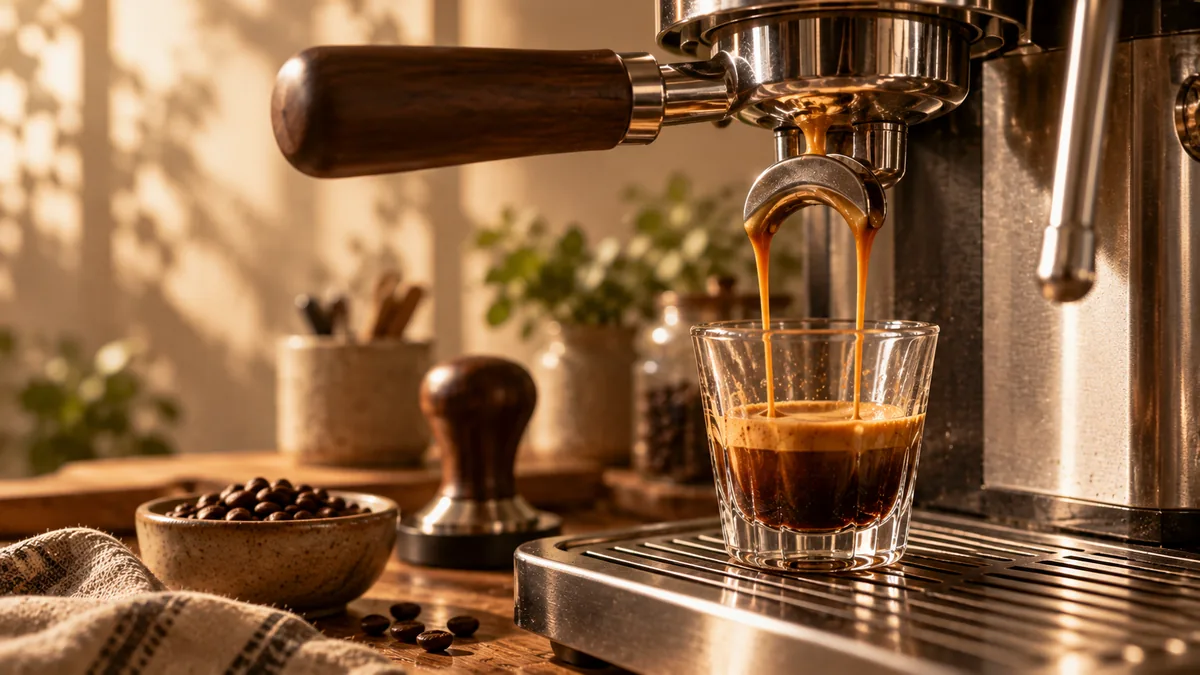
Channeling gets blamed for almost every ugly espresso shot. The useful definition is narrower: water is moving through some parts of the puck more easily than others. Once that happens, the shot stops behaving like one uniform coffee bed.
What channeling actually means
Water takes the easier route. In an espresso puck, a region with lower density or lower resistance can receive more flow than the surrounding coffee. Barista Hustle describes visible channeling as water moving quickly through a localized weak area instead of being shared evenly across the bed.
The important part is not the little jet itself. It is the unevenness behind it. Some grounds see more water, others see less, and the shot becomes harder to extract evenly. That usually shows up as lower clarity, weaker repeatability, or a cup that seems to contain conflicting flavors.
The signs are useful, but none of them is a perfect channeling detector
With a bottomless portafilter, strong channeling can be obvious: a pale jet shoots sideways, the first drops appear heavily in one section of the basket, or one patch runs much faster than the rest. With a spouted portafilter, the same problem may only look like turbulent or watery flow.
There is a catch. Barista Hustle makes a useful distinction between large visible channels and smaller variations in flow that you cannot see. Eliminating a dramatic spray does not prove that the puck is extracting evenly. The reverse is also worth remembering: a cosmetic-looking flow pattern is not a substitute for tasting the espresso.
Fix channeling in this order
- Keep the dose fixed. Weigh the same amount of coffee for each comparison.
- Distribute evenly. Break up obvious clumps and avoid leaving a mound on one side.
- Tamp level. Check for tilt before brewing.
- Repeat the target yield. Compare flow and taste with the same amount of espresso in the cup.
- Then assess grind. If prepared shots are consistently fast or slow, use the Dial-In Assistant to choose one adjustment.
That gives you a baseline. If the first shot sprays from the right and the next shot, at the same settings, gushes from the left, changing the grinder is not the cleanest experiment. The preparation is moving around more than the recipe.
| What you notice | Check first | Do not change yet |
|---|---|---|
| Shot pattern changes wildly between pulls | Dose, distribution, level tamp | Recipe and temperature |
| Side spray from a bottomless basket | Distribution near the basket edge and tamp level | Large grind moves |
| Clumpy grounds before tamping | Declumping / WDT | Yield |
| Even prep, repeatably fast and sour | Grind slightly finer | Dose and target yield |
| Even prep, repeatably slow and bitter | Grind slightly coarser | Dose and target yield |
Where WDT helps — and where it does not
WDT, or the Weiss Distribution Technique, is simply a way of stirring espresso grounds with fine needles before tamping. Barista Hustle notes that the technique breaks up clumps and evens out density through the puck, which can reduce channeling and improve extraction evenness.
It is most useful when the coffee lands in the basket in clumps or piles up unevenly. The goal is not to perform an elaborate ritual. Reach through the depth of the grounds, break up obvious clumps, leave the bed reasonably level, and then tamp.
A WDT tool cannot rescue an unsuitable dose, a wildly wrong grind setting, or a crooked tamp. It is one preparation step. If your grinder already produces fluffy grounds and your shots are repeatable, adding more puck-prep accessories is not automatically an upgrade.
When grind size really is the next move
Once preparation is repeatable, grind becomes much easier to read. If the shot repeatedly reaches the target yield too quickly and tastes sour or thin, move a little finer. If it repeatedly crawls and tastes bitter or drying, move a little coarser.
The word repeatedly matters. One strange shot is not enough evidence for a big adjustment. Pull the same recipe again after cleaning up the puck prep. If the same fast-or-slow behavior returns, now the grinder is giving you useful information.
Why channeling can make espresso taste sour and bitter at once
“Sour and bitter together” is useful because it warns you not to treat the puck as if it extracted uniformly. Barista Hustle's work on uneven extraction points to smaller flow variations as a reason the extraction ceiling can fall even when there is no spectacular visible channel.
In practical terms, a mixed, confusing cup plus unstable flow is a good reason to repeat the shot with cleaner distribution and a level tamp. If the next shot becomes sweeter and more coherent without changing the recipe, that tells you more than the first timer reading ever could.
A bottomless portafilter is a diagnostic window, not a quality meter
A naked or bottomless portafilter is useful because it exposes the underside of the basket. You can see obvious sprays and uneven starts that a spouted portafilter hides. Barista Hustle also points to naked portafilters as a useful way to spot distribution or tamping problems.
But do not turn the appearance of the stream into a new obsession. A beautiful center cone does not prove the puck is microscopically even, and a minor visual imperfection does not automatically make the cup bad. Use the view to improve consistency, then go back to the espresso itself.
Troubleshoot the shot you actually pulled
Use taste, flow, and timing together.
The Espresso Dial-In Assistant treats uneven or spraying flow differently from a simple fast or slow shot, so it will tell you when to repeat the puck prep before touching the grinder.
Espresso channeling FAQ
What is espresso channeling?
Channeling is uneven water flow through the coffee puck. Water finds lower-resistance paths, so different parts of the puck are extracted differently and the shot becomes less even and less repeatable.
How can I tell if my espresso is channeling?
A bottomless portafilter can reveal obvious problems such as side sprays, pale fast jets, or extraction that starts heavily in one area. Shot-to-shot inconsistency and a cup that tastes both sharp and harsh can also point to uneven extraction. Visible flow is useful evidence, but it is not a perfect measurement of everything happening inside the puck.
Does WDT help with espresso channeling?
It can. WDT uses fine needles to break up clumps and redistribute coffee through the basket before tamping. It is most useful when the grounds arrive clumpy or unevenly distributed.
Should I grind finer to fix channeling?
Not automatically. If distribution or tamping is uneven, changing grind can hide the symptom without fixing the cause. Make the puck preparation repeatable first, then use grind to dial in flow and taste.
Does spraying from a bottomless portafilter always mean the shot will taste bad?
A visible spray is evidence of a strong local flow path and worth correcting, but visible channels are not the whole story. Smaller variations in flow can exist without obvious spraying, so taste and repeatability still matter.