French press guide
Make French press coffee with one recipe you can actually learn from.
Start with a clear ratio, coarse grind, hot water, and a four-minute steep. Brew once, taste, then change one thing instead of rebuilding the whole recipe.
Updated
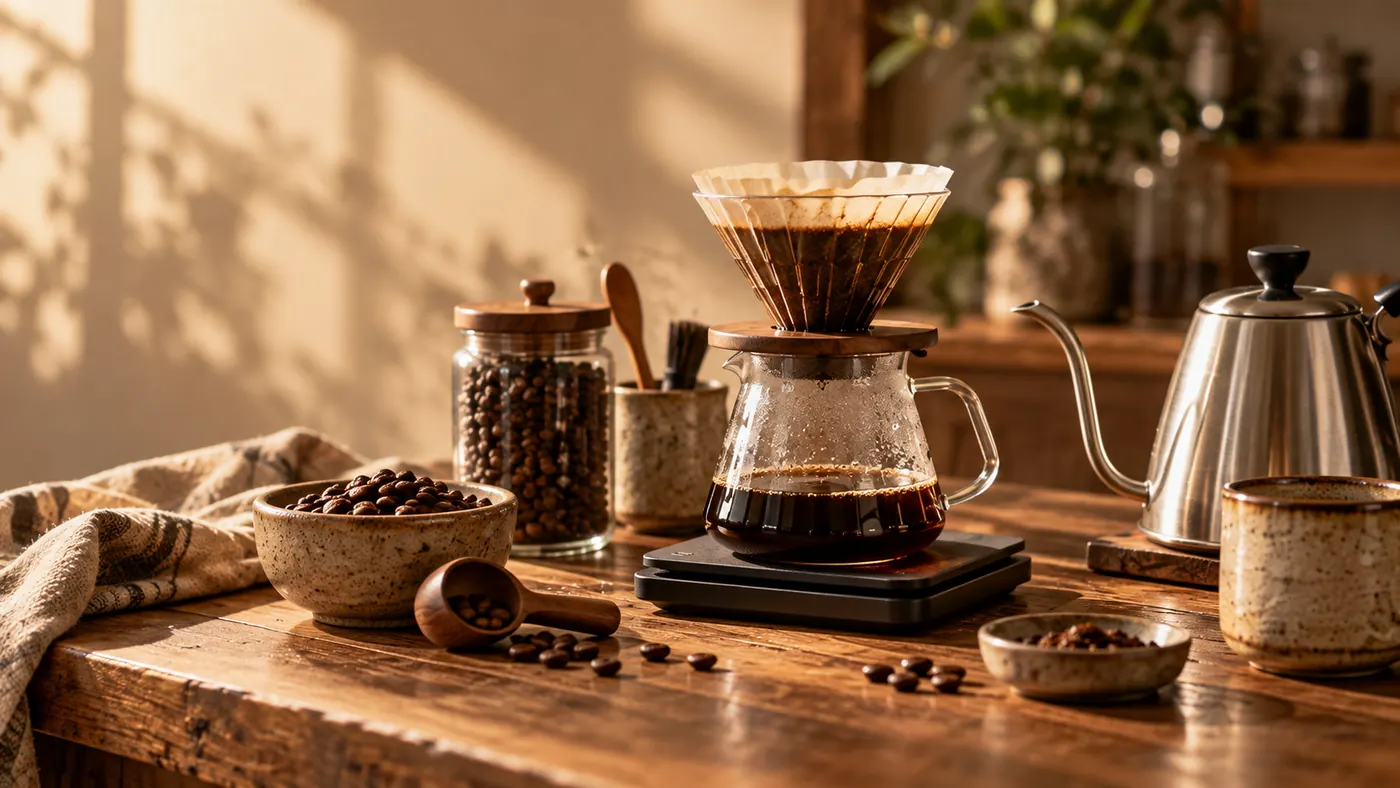
French press is an immersion method: the coffee and water stay together for most of the brew instead of water draining through a coffee bed. That makes the method forgiving, but consistency still matters. A repeatable first recipe gives the second brew something useful to teach you.
This is a starting point, not a universal perfect recipe. The Specialty Coffee Association describes 60 g/L as a commonly used brewing ratio for drip and immersion coffee, which equals roughly 1:16.7. Stumptown's published French press method uses 56 g of coffee with 850 g of water — a stronger recipe near 1:15 — with a coarse grind, water around 205°F, and a four-minute brew. The useful lesson is the range, not a magic number.
1. Choose your French press coffee-to-water ratio
Use the water you plan to add, not the finished drink volume or the brewer’s advertised cup count. These rounded doses are calculated from 60 g/L and 1:15; they are starting recipes. Leave room for the grounds and follow your brewer’s fill limit.
| Water to add | Starting dose 60 g/L | Stronger option 1:15 |
|---|---|---|
| 250 g ≈ 250 ml | 15 g | 17 g |
| 300 g ≈ 300 ml | 18 g | 20 g |
| 500 g ≈ 500 ml | 30 g | 33 g |
| 750 g ≈ 750 ml | 45 g | 50 g |
| 1,000 g ≈ 1 liter | 60 g | 67 g |
Ratio controls beverage strength more directly than most brewing variables. At the Measured Bloom starting ratio, 300 g of water needs about 18 g of coffee, 500 g needs about 30 g, and 1 liter needs about 60 g. If you know you enjoy a heavier cup, moving toward 1:15 is a reasonable later experiment.
Do not change ratio just because the coffee tastes sour or bitter. First ask whether the cup is simply too weak or too strong. If the flavor is balanced but the drink feels thin, use a little more coffee next time. If the flavor is balanced but the drink feels heavier than you want, use a little less coffee or more water. If the flavor itself is sharp, hollow, harsh, or drying, grind and contact time are usually cleaner variables to test first.
No scale? Tablespoons are a rough fallback, not a second ratio system
Searches for French press measurements often start with a kitchen spoon rather than a scale. Stumptown's published French press recipe lists 56 g of coffee as about 8 tablespoons for an 850 g batch. That is roughly 7 g per tablespoon in that specific recipe.
Using the same rough conversion, the 18 g coffee dose in the Measured Bloom 300 g starting recipe is about 2½ tablespoons. Treat that as a convenience estimate: roast level, grind size, bean density, and how full the spoon is can all change the volume. If you are trying to repeat or dial in a recipe, grams are the more dependable measurement.
2. Start coarse, then let taste move the grinder
A coarse grind is the conventional French press starting zone. Stumptown describes its grind as coarse, similar to breadcrumbs. The exact label on your grinder is less useful than it sounds because “coarse” is not standardized between grinders.
For the first brew, aim for visibly coarse, fairly even particles and keep everything else fixed. If the finished coffee tastes sour, hollow, or unfinished while strength seems reasonable, try one small move finer. If it tastes harsh, drying, or unpleasantly bitter, try one small move coarser. Make the change small enough that you can learn from the result.
If you are unsure where your grinder should begin, use the Grind Size Finder. If your grinder model is supported, the Grinder Setting Finder can give you a model-specific starting number instead of a vague label.
3. Use hot water as a starting setting, not a score
Water around 200–205°F (93–96°C) is a practical starting zone for French press. Stumptown's published method uses water just off the boil at about 205°F. You do not need to hit one exact temperature for every coffee.
Roast level can nudge the starting point. A lighter roast can tolerate a hotter start, while a darker roast may taste cleaner a little cooler. Make those changes only after the basic recipe is repeatable. Moving temperature, grind, ratio, and time together makes it impossible to know which change helped.
The Brew Temperature Finder can give you a roast-aware starting point without pretending there is one correct temperature for every bean.
4. Brew it in six repeatable steps
Step 1: Preheat the brewer
Rinse the empty French press with hot water, then discard the rinse. This is optional for casual brewing, but it reduces how much heat the brewer absorbs when the actual brew begins. Stumptown includes this step in its published method.
Step 2: Weigh and grind
For a 300 g batch, weigh 18 g of coffee and grind it coarse. Add the grounds to the brewer and level them gently. Using a scale removes one source of variation before you start troubleshooting taste.
Step 3: Add the water
Start the timer as you add hot water. Wet all of the coffee rather than leaving dry islands on the surface. You do not need a complicated pouring pattern because the coffee will remain immersed.
Step 4: Keep agitation consistent
Choose a simple routine and repeat it. Stumptown adds part of the water first, stirs at one minute, then fills to the final water weight. You can use that pattern or another simple immersion routine; the important part for dialing in is not changing the agitation every brew.
Step 5: Press around four minutes
Four minutes is a practical reference point and the timing used in Stumptown's guide. Press with steady pressure rather than forcing the plunger aggressively. If the press is extremely difficult, the grind may be finer than your current recipe needs.
Step 6: Pour the brewed coffee out
Serve the coffee after pressing. If you are not drinking the whole batch right away, transfer the remainder to a carafe instead of leaving it sitting with the grounds. Stumptown specifically recommends this to avoid continued extraction and bitterness.
5. Change the variable that matches the problem
The easiest way to waste a bag of coffee is to change everything after one disappointing cup. Separate strength from flavor first, then make one test.
| What the cup tells you | Best first test | Keep steady |
|---|---|---|
| Balanced but weak | Use a little more coffee | Grind, temperature, steep time |
| Balanced but too strong | Use a little less coffee or more water | Grind, temperature, steep time |
| Sour, hollow, or unfinished | Try one small step finer | Ratio and steep time |
| Harsh, bitter, or drying | Try one small step coarser | Ratio and steep time |
| Different every brew | Standardize dose, water, time, and agitation first | Do not chase the grinder yet |
If you do not know which clue matters most, use the Brew Troubleshooter. It is designed to turn the method, taste, and brew behavior into one next adjustment.
6. If the cup is muddy or full of sediment
French press uses a metal mesh rather than a paper filter, so some fine sediment is normal. If the cup feels excessively muddy, start by improving grind consistency and moving slightly coarser. Avoid aggressive stirring that can keep more fine particles suspended, press steadily, and leave the final sediment-heavy splash behind if necessary.
Do not make sludge the only quality target. A perfectly clear cup is not what a French press is designed to produce. The goal is a texture you enjoy without letting fines or harshness dominate the drink.
Use the cup as feedback
Brew once. Then choose one next move.
Keep the baseline steady, describe what happened, and let the Brew Troubleshooter choose the next useful test.
French press FAQ
What coffee-to-water ratio should I use for French press?
A useful first brew is 60 grams of coffee per liter of water, about 1:16.7. If you prefer a heavier cup, a stronger recipe around 1:15 is also common. Keep the ratio fixed for the first brew, taste it, then adjust.
How many tablespoons of coffee should I use for French press?
Use tablespoons only as a rough fallback because ground coffee volume changes with the bean and grind. Stumptown lists 56 grams as about 8 tablespoons in its French press recipe. For the 18-gram Measured Bloom starting dose, about 2½ tablespoons is a practical no-scale estimate.
What grind size works for French press?
Start coarse, around a breadcrumb-like texture. Grind labels are not standardized, so use the cup rather than the label: move slightly finer if the coffee tastes hollow or sour, and slightly coarser if it is harsh or drying.
How long should French press coffee steep?
Four minutes is a practical baseline. Stumptown uses a four-minute brew in its French press guide. Treat time as a repeatable starting point, then change only one variable after tasting.
What water temperature should I use for French press?
Around 200–205°F (93–96°C) is a useful starting zone. Stumptown uses water around 205°F. Roast level and taste can justify a small adjustment rather than a large jump.
Should I leave coffee in the French press after plunging?
It is better to pour the brewed coffee out rather than leave it sitting with the grounds. If you are not serving it all immediately, transfer the remainder to a carafe.