Brew Troubleshooter
Tell us what the cup did. Change one thing next.
Choose the brew method, what you tasted, and what happened during the brew. Measured Bloom will suggest one next test instead of asking you to reset the whole recipe.
Keep the recipe.
A balanced cup does not need a correction just because the clock or flow looks different from someone else’s recipe.
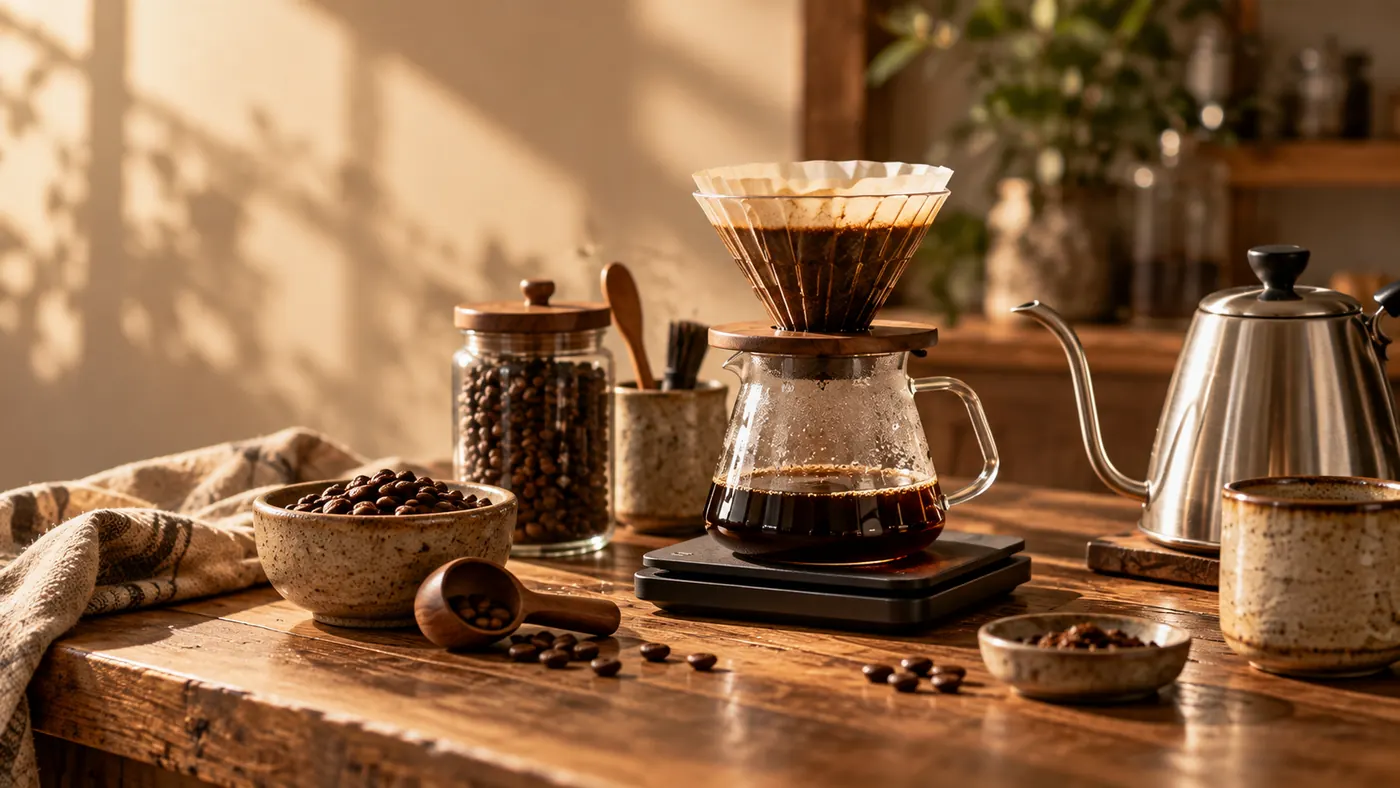
How the troubleshooter decides what comes next
The tool separates three things that are often mixed together: beverage strength, extraction direction, and brewing consistency. SCA research shows that strength and extraction can affect sensory perception independently, so “weak” is not treated as a synonym for “under-extracted.”
For sour or hollow coffee, the tool looks for a clean way to increase extraction. For bitter or drying coffee, it looks for a clean way to back off. Barista Hustle describes the same broad extraction direction, while also warning that sourness and bitterness together can point to uneven extraction rather than a simple finer-or-coarser answer.
Flow matters most when taste agrees
For pour over and drip, a fast brew plus sour or hollow flavor supports a small move finer. A slow brew plus bitter or drying flavor supports a small move coarser. When the clues conflict — slow and sour, or fast and bitter — the tool asks for a repeat and a consistency check before using the timer to move the grinder.
Immersion brewing uses contact time differently
French press and cold brew do not need a drawdown target to extract correctly. Breville's extraction guidance and Toddy's experiment framework both support treating grind and contact time as separate variables. A short steep plus hollow flavor makes a longer steep a clean first test; a long steep plus harsh, drying flavor makes a shorter one a clean first test.
Why the answer is only one change
Toddy's cold-brew experiment guide explicitly recommends changing one brewing parameter while keeping the others constant. That is also the logic behind this tool. If you move grind, ratio, time, temperature, and technique together, the next cup cannot tell you which change mattered.
Brew Troubleshooter FAQ
Why does the Brew Troubleshooter separate weak coffee from sour coffee?
Weak describes beverage strength, while sour or hollow flavor can point toward extraction. Treating them as the same problem can send you toward the wrong adjustment.
Why is espresso not included?
Espresso has its own Dial-In Assistant because dose, beverage yield, basket type, puck preparation, shot time, flow, and taste interact more tightly than they do in most filter or immersion brewing.
Does fast flow always mean I should grind finer?
No. If the cup is balanced, keep the recipe. If fast flow comes with bitter or drying flavor, that is a conflicting signal and the tool asks you to repeat and check consistency instead of blindly moving finer.
Why does the tool recommend changing only one thing?
Changing one variable at a time makes the next brew informative. Toddy uses the same experiment principle for cold brew, and it is equally useful for grind, ratio, contact time, temperature, and technique.
References:Barista Hustle — Coffee Extraction: The 80:20 Method·Barista Hustle — Extract More Better·Breville — Coffee Extraction Process·Toddy — Cold Brew Experiment Guide·SCA — Towards a New Brewing Chart