Espresso beginner guide
Pressurized vs. non-pressurized baskets: use the one that fits your grinder.
A non-pressurized basket is not automatically an upgrade. If your grinder cannot control espresso grind size, the more forgiving basket may give you the better cup.
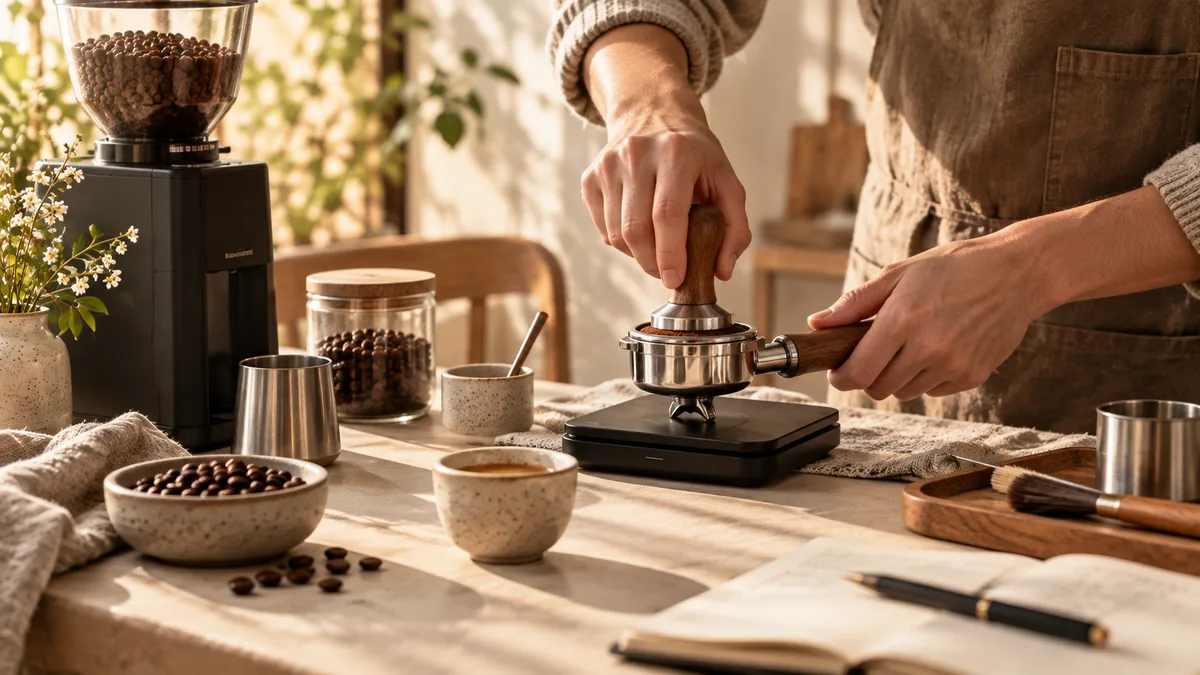
The confusing part is that people often talk about a “pressurized portafilter.” In most home setups, the important difference is actually the filter basket sitting inside the portafilter. The basket determines whether the outlet itself adds resistance or whether the coffee puck must create most of that resistance.
What a pressurized basket actually does
A pressurized basket is usually a dual-wall design. Coffee first passes through the inner basket, then the brewed liquid is forced through a much smaller outlet in the second wall. That restriction creates extra back pressure at the basket itself.
The practical effect is forgiveness. If the grind is a little too coarse, the distribution is imperfect, or the coffee was ground before you got home, the restricted outlet can still slow the flow enough to produce a usable espresso-style shot. That is why manufacturers commonly pair dual-wall baskets with beginner machines and recommend them for pre-ground coffee.
What changes with a non-pressurized basket
A non-pressurized, or single-wall, basket has many open holes across the base and does not add the same outlet restriction. The coffee puck now has to provide the resistance that controls the shot.
That gives you more control, but it also exposes mistakes more clearly. Grind a little too coarse and the shot may gush. Grind too fine and it may choke. Uneven distribution or a crooked tamp can create uneven flow. This is why a single-wall basket can produce excellent espresso when the grinder and puck preparation are good — and frustrating espresso when they are not.
The grinder is the real decision point
If you remember one thing from this page, make it this: do not switch baskets before asking whether your grinder can handle espresso.
An espresso-capable grinder needs two things: the ability to grind fine enough, and enough adjustment resolution to make small changes between “too fast” and “too slow.” A grinder that is perfectly good for French press or drip coffee may not give you enough control for a non-pressurized espresso basket.
| Your setup | Better starting basket | Why |
|---|---|---|
| Pre-ground coffee | Pressurized | More tolerant of grind size and freshness you cannot adjust shot by shot |
| Basic grinder with large adjustment steps | Pressurized | The basket helps compensate when the grinder cannot land precisely in the espresso range |
| Fresh beans + espresso-capable grinder | Non-pressurized | You can use grind size to control flow and tune taste directly |
| You want the easiest morning routine | Pressurized is reasonable | It is more forgiving of small preparation differences |
| You enjoy dialing in and learning puck prep | Non-pressurized | It gives your grinder and technique more influence over the shot |
Should you switch just because people online say to?
No. A common beginner pattern is to buy a machine with a pressurized basket, read that a non-pressurized basket is “better,” switch immediately, and then discover that the existing grinder cannot control the new setup. The result can be more inconsistency, not better coffee.
Switch when the rest of the setup is ready. If you already have fresh coffee, a capable grinder, a scale, and a repeatable puck-preparation routine, a single-wall basket gives you more room to improve the shot by taste. If one of those pieces is missing, the pressurized basket can remain useful.
Dialing in works differently with each basket
With a non-pressurized basket
Grind changes have a strong effect on flow. If an otherwise repeatable shot runs fast and tastes sour or thin, a small move finer is often the cleanest next test. If it crawls and tastes harsh or dry, a small move coarser is often useful. Dose and target yield should stay steady while you test the grind change.
With a pressurized basket
The restricted outlet adds its own resistance, so the relationship between grind and visible flow is less direct. Keep dose and beverage yield consistent, but do not chase a textbook shot time as aggressively. Taste and repeatability matter more than forcing the timer toward one number.
How to tell which basket you have
Remove the basket and look at the underside. A single-wall basket normally shows many open holes across the base. A dual-wall basket has a second layer underneath that restricts the brewed coffee to a much smaller exit area, often one central hole.
If the outside shape is unclear, check the machine manual. Manufacturers may call them single wall and dual wall, or non-pressurized and pressurized. Those terms describe the basket more reliably than the shape of the portafilter handle or whether the portafilter has a spout.
Use the setup you actually own
Do not diagnose a pressurized shot like a single-wall shot.
The Espresso Dial-In Assistant asks which basket you are using so the next adjustment reflects how that setup controls flow.
Pressurized vs. non-pressurized basket FAQ
Should a beginner use a pressurized or non-pressurized espresso basket?
A pressurized basket is usually the easier starting point when you are using pre-ground coffee or do not have an espresso-capable grinder. A non-pressurized basket gives you more control, but it also makes grind quality and puck preparation much more important.
Do I need a better grinder before switching to a non-pressurized basket?
Usually, yes. A non-pressurized basket relies on the coffee puck to create resistance, so the grinder needs to produce a fine, reasonably even espresso grind and allow small adjustments. Without that control, shots may run too fast, choke, or vary from one pull to the next.
Is a pressurized basket bad espresso?
No. It is a different tool for a different setup. It is designed to be more forgiving of pre-ground coffee, grind inconsistency, and beginner puck preparation. If it makes coffee you enjoy consistently, there is no requirement to replace it.
How can I tell which basket I have?
A single-wall basket usually shows many open holes across the underside. A dual-wall or pressurized basket has a second layer that restricts the outlet, often leaving one small exit hole or a very limited outlet area.
Does shot time mean the same thing with both basket types?
Not exactly. With a non-pressurized basket, grind and puck resistance have a more direct effect on flow. A pressurized basket adds resistance at the basket outlet, so shot time and visible flow are less direct clues about grind size. Taste and repeatability deserve more weight.