Pour-over troubleshooting
Pour-over draining too fast or too slow? Diagnose it before changing the grind.
Fast and slow brews can both be good. The useful question is whether your pour-over changed in a way the cup confirms — and whether grind, agitation, filter flow, or technique is the cleanest next adjustment.
Updated
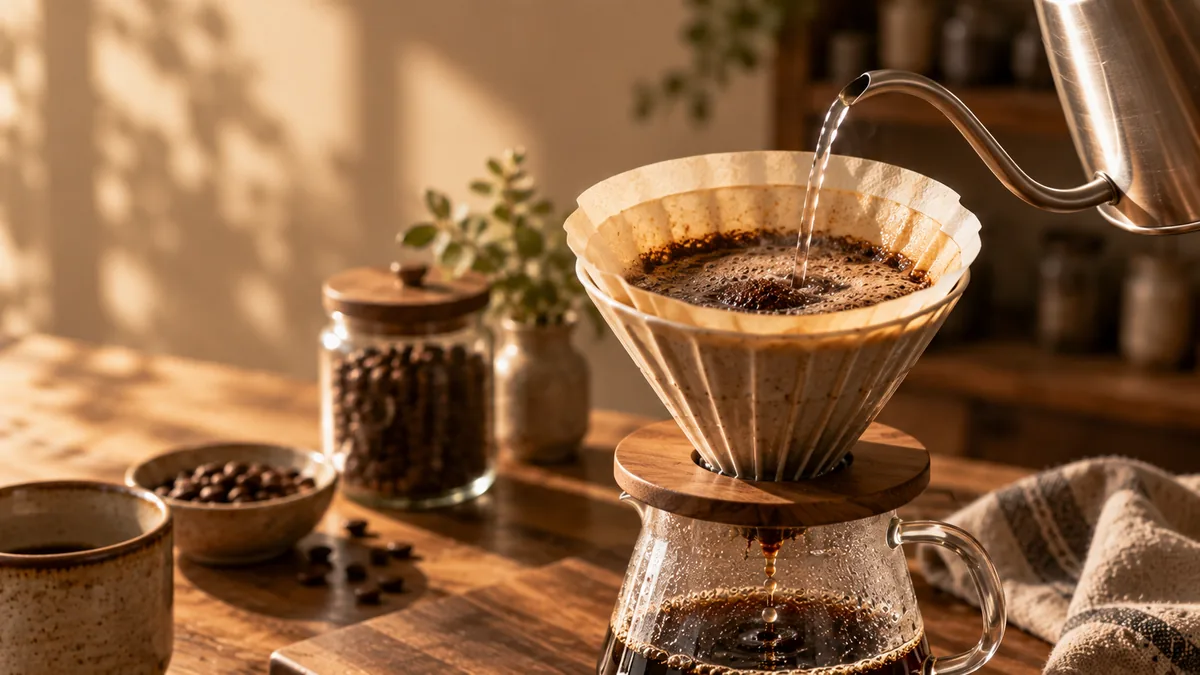
The clock is useful because it tells you that something changed. It is not useful when it convinces you to “fix” a cup that already tastes good.
- Fast and sour or hollow: try one small step finer.
- Slow and bitter or drying: try one small step coarser.
- Stalls after stirring or swirling: reduce agitation first.
- Suddenly slower with new paper: check filter fit and flow.
- Sweet and balanced: keep the recipe, even if the timer differs.
Keep dose, water weight, temperature, and pouring pattern steady while testing one change. If taste and flow disagree, use the Brew Troubleshooter before choosing a grind adjustment.
First, separate brew time from drawdown
Barista Hustle uses drawdown for the final drainage phase after the last water addition. Home brewers often use the word more loosely for the whole brew. Either convention works for troubleshooting as long as you record it the same way every time.
That consistency matters because published pour-over recipes do not share one finish time. Hario's 1-cup James Hoffmann V60 recipe aims to finish around 3:00 and explicitly says to expect variation. Its larger 30 g / 500 g version aims closer to 3:30. Hario also publishes a Mugen recipe around 1:30. Different dose, filter, geometry, and pouring structure can move the clock dramatically.
So start with your own baseline. If a coffee that normally finishes near 3:10 suddenly drops through at 2:25 with the same dose and filter, that change is worth investigating. Comparing your 15 g V60 with somebody else's 30 g Chemex is much less useful.
If your pour-over drains too fast
When fast flow comes with a sour, sharp, hollow, or thin cup, grind is the cleanest first test. Move a small step finer. Keep the coffee dose, water amount, temperature, bloom, and pouring pattern unchanged, then brew again.
Official Chemex troubleshooting uses the same basic relationship: coffee that filters too quickly is likely ground too coarse, so the recommended correction is a finer grind. Kalita's brewing guidance likewise suggests going finer when the cup is sour.
| Fast brew +... | Try first | Why |
|---|---|---|
| Sour / hollow / thin | One small step finer | Add resistance and extraction opportunity. |
| Sweet / clear / balanced | Nothing | A fast brew is not a failure by itself. |
| Weak but otherwise clean | Check ratio before forcing a slower brew | The problem may be concentration rather than extraction. |
| Sharp and drying at once | Check even wetting and pouring consistency | Conflicting flavors can point to uneven flow rather than a simple coarse-grind problem. |
Do not make a giant grind change because one brew finished early. A fresh bag, a different filter pack, a smaller dose, or a cleaner grinder can all shift flow. Make the smallest change that gives you a useful comparison.
If your pour-over drains too slowly
A slow brew that is also bitter, harsh, muddy, or drying often benefits from a slightly coarser grind. Chemex's official FAQ lists a grind that is too fine as the first cause of slow filtration. Again, the useful part is that the flow clue and the taste clue agree.
But slow drawdown is not always a grind problem. Fines can migrate into the filter and choke it. A new paper can flow differently from the old one. A larger batch creates a deeper bed. Some drippers deliberately restrict flow more than others. If you immediately go much coarser, you may fix the timer while making the cup thin and under-extracted.
| Slow brew +... | Try first | Also check |
|---|---|---|
| Bitter / drying / muddy | One small step coarser | Filter fit and excessive agitation |
| Sweet / balanced | Keep the recipe | Nothing unless repeatability is poor |
| Suddenly much slower | Repeat the same recipe once | Filter, fines, grinder retention, pour pattern |
| Slow but sour | Do not blindly grind coarser | Uneven wetting, low temperature, or a recipe mismatch |
Too much agitation can turn fines into a traffic jam
Swirling and stirring are not automatically bad. They can help wet the coffee evenly and settle the bed. The problem is treating more agitation as a free way to increase extraction.
Barista Hustle warns that agitating down into the coffee bed can move excess fines toward the paper and block its pores. In its drawdown lesson, an over-agitated brew designed for about three minutes stretches several minutes longer. That is a different failure mode from simply grinding too fine.
If your brewer drains normally until you add an aggressive stir, shake, or repeated swirl, simplify the movement before moving the grinder several steps coarser. A gentle settling swirl is very different from stirring through the whole bed.
The filter and brewer are part of the flow system
Paper filters are not interchangeable. Hario notes that filter paper affects drawdown, and Kalita designs its Wave filters and brewer together to control contact and flow. Chemex uses a much thicker bonded filter, so a Chemex and a V60 should not be expected to finish on the same schedule.
Filter fit matters too. Chemex specifically warns that a filter sealing the pour spout can slow or flood the brew. With any brewer, make sure the paper is seated correctly and the intended drainage path is open before blaming the coffee.
A good cup is allowed to ignore your target time
Hario's own 1-cup V60 recipe says taste is the most important thing even while giving an approximate three-minute finish. That is the right hierarchy for troubleshooting.
If the brew is faster than your usual target but sweet, aromatic, and complete, leave it alone. If it is slower but clear and balanced, leave that alone too. Time becomes actionable when it changes and the cup gives you a reason to care.
When you are unsure, run a three-brew test
This is slower than guessing and much faster than changing everything for a week.
| Brew | Change | What you learn |
|---|---|---|
| A — Baseline | Current recipe | Confirm the taste and finish time you are trying to fix. |
| B — Grind test | One small step finer or coarser | See whether flow and flavor move together. |
| C — Technique test | Return to the old grind; simplify agitation and repeat the pour | See whether consistency improves without a grind change. |
Keep the dose, final water weight, water temperature, brewer, and filter the same across all three. Write down the finish time and taste after the coffee cools a little. If Brew B improves sweetness and balance, grind was probably the useful lever. If Brew C fixes the problem instead, technique or fines migration was doing more of the damage.
One change, then brew again
Use grind as a controlled test, not a panic button.
The Grind Size Finder gives you a relative starting zone and a one-step finer or coarser recommendation based on the brew method and what happened in the cup.
Pour-over drawdown FAQ
Why is my pour-over draining too fast?
If the same recipe suddenly runs much faster and the cup tastes sour, hollow, or thin, the grind may be too coarse for that coffee, filter, and brewer. Move a little finer and repeat the same dose, water, temperature, and pouring pattern.
Why is my pour-over draining too slowly?
A grind that is too fine is one common cause, but slow flow can also come from fines migrating into the paper, aggressive agitation, a different filter, or a deeper coffee bed. If the cup is bitter or drying as well as slow, try a small move coarser first.
What is a normal pour-over drawdown time?
There is no universal number. Hario publishes V60 recipes that finish around three minutes, 3:30, and even much faster depending on brewer and method. Compare your brew with its own repeatable baseline and use taste to decide whether the time is actually a problem.
Should I grind finer if my pour-over is fast?
Usually when fast flow comes with sour, hollow, or thin flavor. If the cup is sweet and balanced, do not slow it down just to match someone else’s stopwatch.
Can too much swirling or stirring make a pour-over slow?
Yes. Barista Hustle notes that excessive agitation can move fines through the coffee bed and block pores in the filter paper, extending drawdown well beyond the intended contact time.